
Home › Guides › Motors and drives
Cable Size for Motors: A Planning Guide by Current, Distance and Installation
- Start from nameplate current
- Correct for installation and heat
- Check voltage drop on long runs
- Confirm with an electrician
On this page
Step 1: Find the Motor Current
Use the nameplate full-load current (FLA) at your voltage. As a rough guide, a three-phase 415 V motor draws a little under 2 A per kW at full load, and a single-phase 240 V motor draws far more current for the same power, so single-phase motors need bigger cables.
Step 2: Current Rating and Installation
A cable’s current rating depends on how it is installed (in conduit, on a tray, buried), how many cables are grouped together and the air temperature. Apply the correction factors from the regulations or cable maker so the corrected rating stays above the motor current and coordinates with the breaker or fuse.
Step 3: Voltage Drop
Long cable runs to boreholes, tanks or far workshops lose voltage. Low voltage at the motor raises current and heat. Check the drop using the cable’s mV/A/m figure: voltage drop ≈ (mV/A/m × current × length) ÷ 1000, and keep it within the limit your electrician applies. If it is too high, go up a cable size.
Planning Table (Indicative Only)
| Motor (3-phase, 415 V) | Approx. full-load current | Planning note |
|---|---|---|
| 2 HP (1.5 kW) | About 3 A | Small cable suffices for short runs; check voltage drop on long runs |
| 3 HP (2.2 kW) | About 4.5 A | As above |
| 7.5 HP (5.5 kW) | About 11 A | Check starting method and voltage drop |
| 10 HP (7.5 kW) | About 15 A | Long runs often need a size up |
These are planning figures only; use the nameplate and the electrician’s calculation for the actual cable.
Safety: cables, breakers, earthing and connections must be designed, installed and tested by a qualified electrician to the wiring regulations. These figures help you plan and ask the right questions; they do not replace an electrical design.
Motors at H-TECH
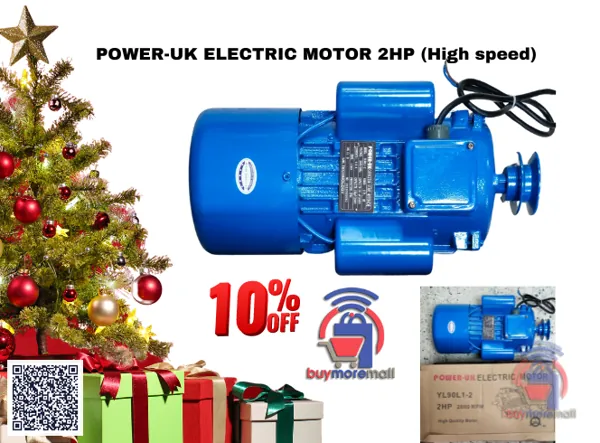 POWER-UK ELECTRIC MOTOR 2HP (High speed)KSh 21,000
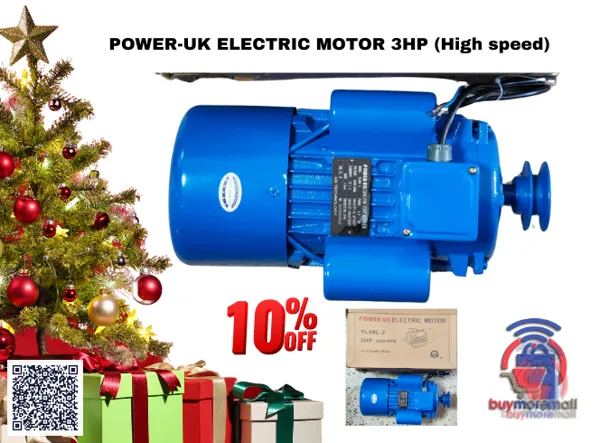 POWER-UK ELECTRIC MOTOR 3HP (High speed)KSh 24,000
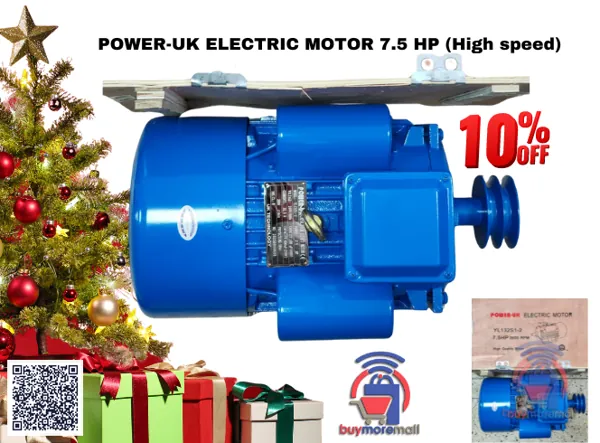 POWER-UK ELECTRIC MOTOR 7.5HP (High speed)KSh 39,000
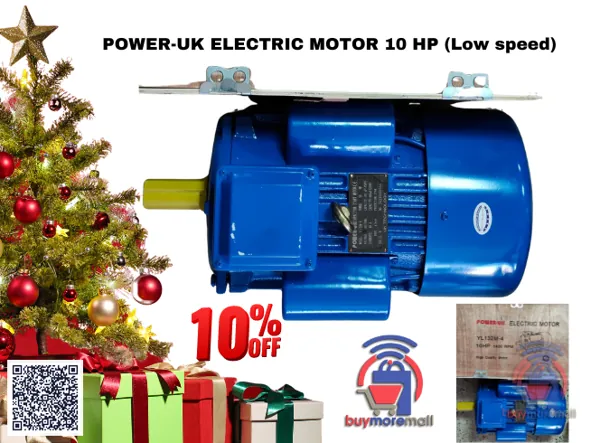 POWER-UK ELECTRIC MOTOR 10HP (Low speed)KSh 45,000
| Product | Price |
|---|---|
| POWER-UK ELECTRIC MOTOR 2HP (High speed) | KSh 21,000 |
| POWER-UK ELECTRIC MOTOR 3HP (High speed) | KSh 24,000 |
| POWER-UK ELECTRIC MOTOR 7.5HP (High speed) | KSh 39,000 |
| POWER-UK ELECTRIC MOTOR 10HP (Low speed) | KSh 45,000 |
Current listed prices incl. VAT (updated 18 November 2026).
Starting method changes the starting current the supply sees: DOL vs star-delta vs soft starter.
Mistakes to Avoid
- Sizing cable by HP alone, ignoring distance.
- Using single-phase figures for three-phase motors (or the reverse).
- Ignoring grouping and hot locations.
- Undersized earth conductors.
Frequently asked questions
How do I calculate cable size for a motor?
Start from full-load current, choose a cable rating above it after installation and temperature corrections, then check voltage drop over the length.
What cable size for a 10 HP motor?
It depends on voltage, current, length and installation; a 10 HP three-phase motor draws about 15 A at 415 V. An electrician should size it.
Does cable length affect cable size?
Yes. Longer runs have more voltage drop and often need a bigger cable.
Why do single-phase motors need bigger cables?
They draw more current than three-phase motors of the same power.
Can an undersized cable damage a motor?
Yes. Voltage drop raises current and heat, shortening motor and cable life.