
RO Tank Pressure: Check, Adjust and Recharge Your Reverse Osmosis Storage Tank
- Empty-tank pre-charge about 7–8 psi
- Check only when the tank is empty
- Use a low-pressure gauge
- Water at the air valve = failed bladder
On this page
How an RO Pressure Tank Works
An RO membrane makes water slowly, so a small tank stores it. Inside is a rubber bladder or diaphragm with water on one side and pressurised air on the other. As the tank fills, the air is squeezed and pushes water out when you open the faucet. Wrong air pressure means a slow tap, a tank that never fills, or a system that keeps running.
What Pressure Should an RO Tank Be?
| Situation | Typical reading |
|---|---|
| Empty tank, air side | About 7–8 psi (follow the tank label) |
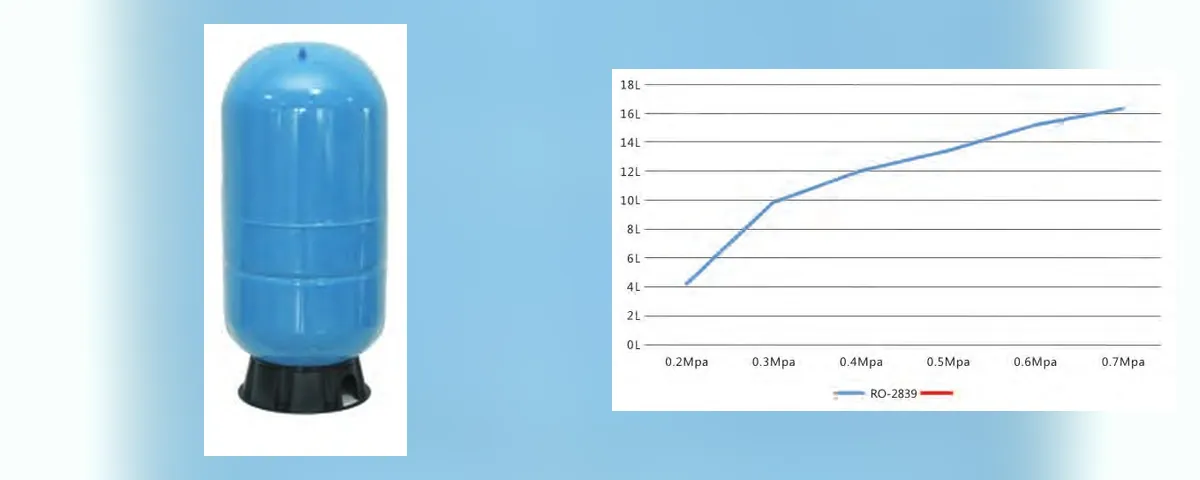
| Full tank | Rises toward about two-thirds of the feed pressure |
| Feed pressure needed | Usually 40–60 psi for a domestic system; low feed means a small, slow fill (consider a booster pump) |
How to Check RO Tank Pressure (Step by Step)
- Close the feed (inlet) valve to the RO system.
- Open the RO faucet and let it run until it stops; leave it open.
- The tank is now empty of water. Find the air valve (a car-tyre style valve, often under a cap).
- Read the pressure with a low-pressure tyre gauge.
- If it is low, add air with a bicycle or hand pump; if high, release a little.
- Close the faucet, open the feed valve and let the tank refill (often 2–4 hours).
Signs of a Bad RO Tank
- Water spurts from the air valve: the bladder is torn.
- Tank feels heavy and full but little water comes out: air charge lost.
- Tank will not hold air after recharging.
- Rust or bulging on a steel tank.
RO Tank Sizes
| Tank | Usable water (approx.) | Good for |
|---|---|---|
| 2.3 gallon plastic | Up to about 8 L | Small household, under-sink |
| 3.2–5 gallon | About 12–19 L | Families, small offices |
| Larger steel tanks | More storage | Offices, restaurants, clinics |
Usable water is less than the gallon size because of the air side. H-TECH stocks plastic and steel RO tanks on the RO pressure tanks page (price on request).
How to Clean and Sanitise an RO Tank
When you change filters, empty the tank, disconnect it and sanitise it with a food-safe sanitiser at the dose on the label, then refill and drain once or twice before drinking. See RO system maintenance and how to install an under-sink RO.
Mistakes to Avoid
- Checking pressure while the tank still has water (the reading is wrong).
- Using a high-pressure car gauge that cannot read 7 psi accurately.
- Over-pressurising the air side, which leaves little room for water.
- Ignoring low feed pressure when the real problem is upstream.
Watch: RO purifiers and water ATMs
Frequently asked questions
What pressure should an RO tank be?
With the tank empty of water, the air pre-charge is usually about 7–8 psi; follow the label on your tank.
How do I check RO tank pressure?
Close the feed, drain the tank through the faucet until it stops, then read the air valve with a low-pressure tyre gauge.
How do I recharge an RO pressure tank?
With the tank empty, add air through the valve with a hand pump until it reaches the right pre-charge, then refill the tank.
Why is my RO tank not filling?
Low feed pressure, a wrong air pre-charge, a failed bladder, a clogged membrane or a stuck shut-off valve.
How long does an RO tank take to fill?
Often 2–4 hours for a domestic tank, depending on the membrane, feed pressure and temperature.