Home › Guides › Process equipment
Steam Boilers for Dairy, Juice and Food Plants
- Size in kg steam per hour
- Fuel: wood, briquettes, diesel
- Treat feed water
- Registered and inspected
On this page
How Does a Steam Boiler Work?
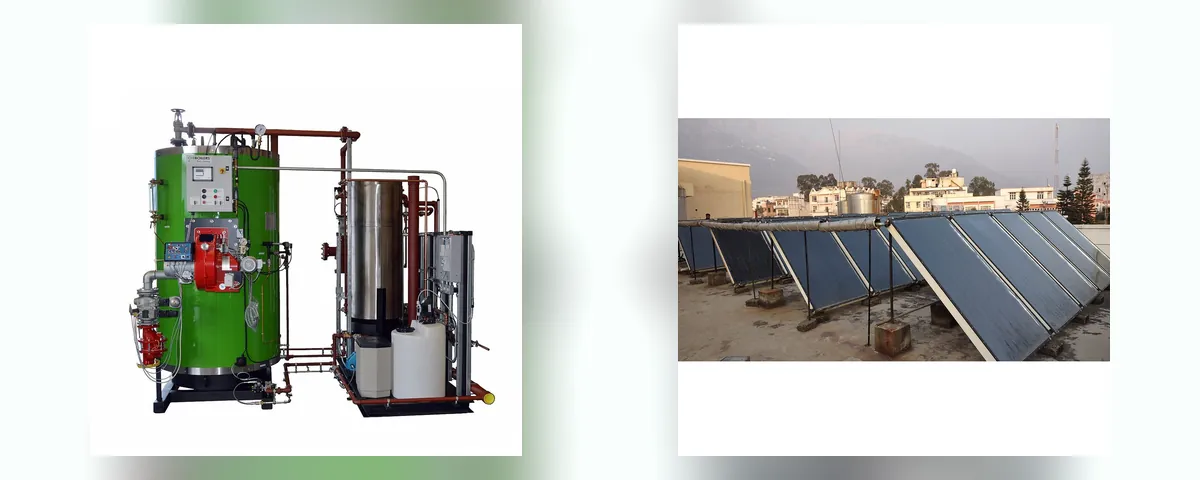
Fuel burns in the furnace, hot gases pass through tubes surrounded by water (fire-tube) or water flows through tubes surrounded by flame (water-tube), and the water boils into steam at a set pressure. Steam carries a lot of heat for its weight and gives it up quickly when it condenses on a pasteuriser plate or tank jacket, which is why food plants use it.
Where Steam Is Used in Food and FMCG Plants
- Milk pasteurisers and yoghurt incubation tanks.
- Juice pasteurising and hot filling.
- Soap saponification tanks and jelly/lotion heating.
- Cleaning-in-place (CIP) hot water and sterilising.
- Cooking kettles, blanchers and smokehouses.
H-TECH supplies a steam boiler for dairy and juice plants from 100 to 2,000 kg/h, and hot water generators and calorifiers for smaller pasteurisers; see dairy processing equipment.
How to Size a Steam Boiler
- List every steam user and its peak heat demand (from the equipment data, usually in kW or kg/h of steam).
- Add the users that run at the same time.
- Convert kW to steam: roughly 1 kg/h of steam delivers about 0.6–0.7 kW of useful heat, depending on pressure.
- Add 20–30% for start-up, losses and growth.
- Check the pressure your equipment needs; most food heating uses low to medium pressure.
Example: a 1,000 L/h milk pasteuriser plus a CIP tank may together need on the order of a few hundred kg/h of steam; your supplier confirms the figure from the exact equipment.
Fuel Options
| Fuel | Pros | Watch out |
|---|---|---|
| Firewood | Cheap in many counties | Needs dry, legal wood, storage and labour |
| Briquettes | Cleaner, steady quality, from waste | Supply contracts; see briquette making |
| Diesel / heavy oil | Automatic, compact | Fuel cost |
| LPG | Clean, automatic | Cost; gas safety |
| Electric | No flue, simple | High power demand; suits small loads |
Feed Water Treatment
Hard or dirty water forms scale on boiler tubes, wastes fuel and can cause dangerous overheating. Use a softener, dose chemicals as advised, return condensate where possible, and blow down regularly. Read boiler feed water treatment.
Safety and Legal Requirements
Under Kenya’s Occupational Safety and Health Act, steam boilers and pressure vessels must be registered with the Directorate of Occupational Safety and Health Services (DOSH) and examined by an approved person at the intervals the law sets. Operators should be trained. Never disable a safety valve, and test low-water cut-offs as the manufacturer instructs. Confirm current requirements with DOSH before installation.
Daily and Weekly Care
- Check water level gauge glass and pressure every shift.
- Blow down the boiler and gauge glass as instructed to remove sludge.
- Test the low-water alarm and cut-off.
- Check the safety valve is free (lift test as allowed by the manual).
- Clean fire tubes and remove soot on schedule; record everything in a boiler log.
Worked Example: Sizing for a Growing Dairy
A dairy processing 2,000 litres a day heats its pasteuriser with an electric heater that struggles at peak. Before expanding to 5,000 litres, the supplier lists the pasteuriser, yoghurt tanks and CIP demand, adds a margin and recommends a firewood or briquette steam boiler with a softener, registered with DOSH before start-up.
Equipment on this page is quoted on request. Send your capacity, power supply and site photos to H-TECH on WhatsApp for a written quotation.
Frequently asked questions
How do I size a steam boiler?
Add the peak steam demand (kg/h) of all equipment running together and add 20–30% margin.
Which fuel is cheapest for a boiler in Kenya?
Firewood and briquettes are usually cheapest per unit of heat where supply is reliable; diesel and electric are more convenient but cost more.
Does a steam boiler need inspection in Kenya?
Yes. Boilers must be registered with DOSH and examined by an approved person at set intervals.
Why is water treatment important for boilers?
Scale and corrosion waste fuel, damage tubes and can make the boiler unsafe.
Do I need a steam boiler for a small dairy?
Small batch pasteurisers can use electric or gas heating or a hot water generator; steam pays off as capacity grows.
Start this as a business
See the full equipment list, budget and step-by-step plan, or get a business pack with your costs and profit worked out.