
Home › Guides › Machine control
Contactors and Motor Control Panels Explained
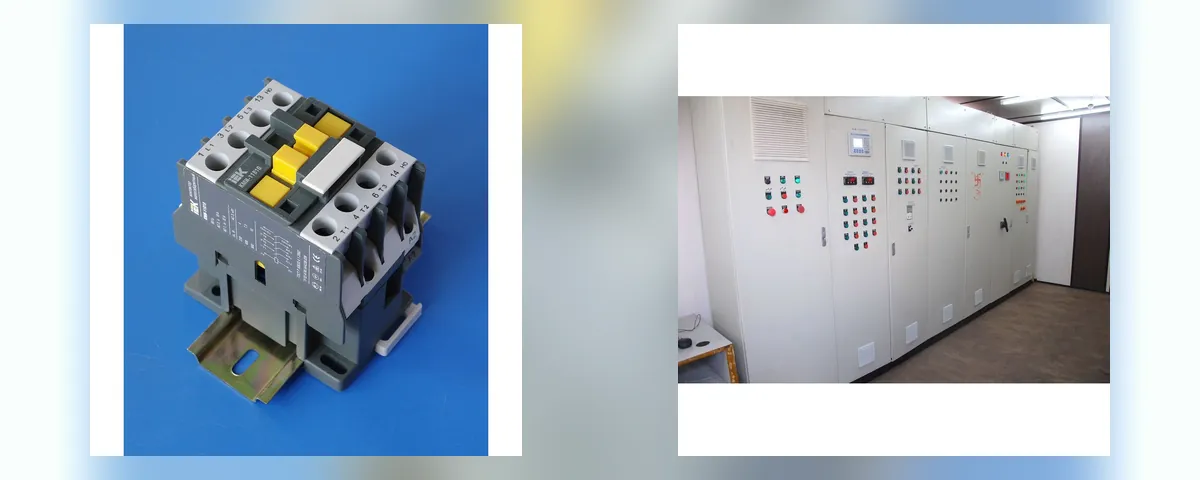
- Coil switches heavy contacts
- Size by AC-3 motor current
- Add overload for a starter
- Electrician wiring only
On this page
How Does a Contactor Work?
Inside the contactor is an electromagnet (the coil) and spring-loaded contacts. When the coil is energised it pulls the contacts closed and power flows to the motor. When the coil is switched off the springs open the contacts. Because the coil only needs a small current, a push button, float switch, timer, PLC or GSM relay can control a large motor safely through it.
Contactor vs Relay
| Relay | Contactor | |
|---|---|---|
| Switches | Small loads and signals | Motors, heaters, big loads |
| Poles | Usually 1–2 | 3 main poles (three-phase) + auxiliary contacts |
| Arc handling | Limited | Arc chambers for motor currents |
| Typical use | Control circuits, PLC outputs | Pump starters, compressors, heaters |
How to Size a Contactor
- Read the motor nameplate: kW and full-load current (FLA) at your voltage.
- Choose a contactor whose AC-3 current rating is at least the motor FLA (AC-1 ratings are for heaters and resistive loads and are higher).
- Match the coil voltage to the control circuit: 230 V AC is common; 24 V AC/DC with PLCs.
- Add auxiliary contacts if you need run lamps, interlocks or feedback to a PLC.
- Pick an overload relay whose range covers the motor FLA, and set it to the nameplate current.
DOL Starter Wiring (In Words)
Power comes through the breaker to the contactor main contacts, then through the overload relay to the motor. The control circuit runs from a control fuse, through the normally closed stop button and the overload’s normally closed contact, to the normally open start button and the contactor coil. An auxiliary contact on the contactor is wired across the start button so the contactor “holds in” after the button is released. Larger motors use star-delta or soft starters: see star-delta vs DOL vs soft starter.
Safety: control panels, contactors, motor circuits and anything on 240/415 V must be designed, wired and tested by a qualified electrician. Isolate and lock off power before opening a panel. This guide helps you plan and ask the right questions.
What Goes Inside a Motor Control Panel
- Main isolator and breaker (MCB or MCCB) sized to the cable and load.
- Contactors, overload relays, or a VFD or soft starter.
- Control fuse or MCB, and a 24 V supply if a PLC is fitted.
- Push buttons, selector switch (hand/off/auto), indicator lamps.
- Phase failure, under/over-voltage and dry-run relays for pumps.
- Terminals, labelled wiring, earth bar, ventilation and a lockable door.
Ready motor starters and panel components, and RO / UF PLC control panels with touch screens, are quoted on the water pumps and water treatment components pages. Cable sizing: cable size for motors.
How to Check a Contactor
- Isolate and lock off power, and prove dead with a tester.
- Measure the coil resistance: open circuit means a burnt coil.
- Inspect the contacts for pitting, burning or welding; check the moving parts are free.
- With power restored (by an electrician), measure coil voltage when the start button is pressed.
- Measure voltage on all three phases in and out with the contactor closed: a big difference across one pole means worn contacts.
Common Faults
| Symptom | Likely cause |
|---|---|
| Contactor buzzes or chatters | Low coil voltage, dirt on the magnet faces, loose control wire |
| Pulls in then drops out | Hold-in auxiliary contact not wired or faulty; overload tripping |
| Motor hums but does not turn | One pole burnt (single-phasing): stop immediately |
| Trips every start | Overload set too low, motor or pump fault, wrong starter type |
Frequently asked questions
What is a contactor used for?
Switching motors, heaters and other large loads with a small control signal.
What is the difference between a contactor and a relay?
A contactor is built for high motor currents with arc chambers and three main poles; a relay switches small loads.
How do I size a contactor for a motor?
Choose an AC-3 rating at least equal to the motor full-load current and the correct coil voltage.
How do I know if a contactor is bad?
Burnt coil (no continuity), pitted or welded contacts, buzzing, or uneven voltage across the poles.
How much is a contactor in Kenya?
Price depends on current rating, coil voltage and brand; send the motor nameplate for a quote.